
What's Actually in Natural Lipstick? An Ingredient-by-Ingredient Guide
Flip over almost any lipstick and you'll find a block of tiny type full of Latin names, parentheses, and mysterious codes like "CI 77491." It's easy to give up and just pick the prettiest shade. But lipstick is one of the few cosmetics you eat a little of every day, so it's worth knowing what's in it. The good news: once you understand the basic recipe, every lipstick label gets a lot easier to read.
The quick answer: Lipstick is made from four building blocks: waxes (structure), oils (glide and shine), butters (comfort), and pigments (color). Natural lipsticks use plant oils and waxes, beeswax, and mineral pigments like iron oxides and titanium dioxide, instead of petroleum-derived ingredients and synthetic dyes.
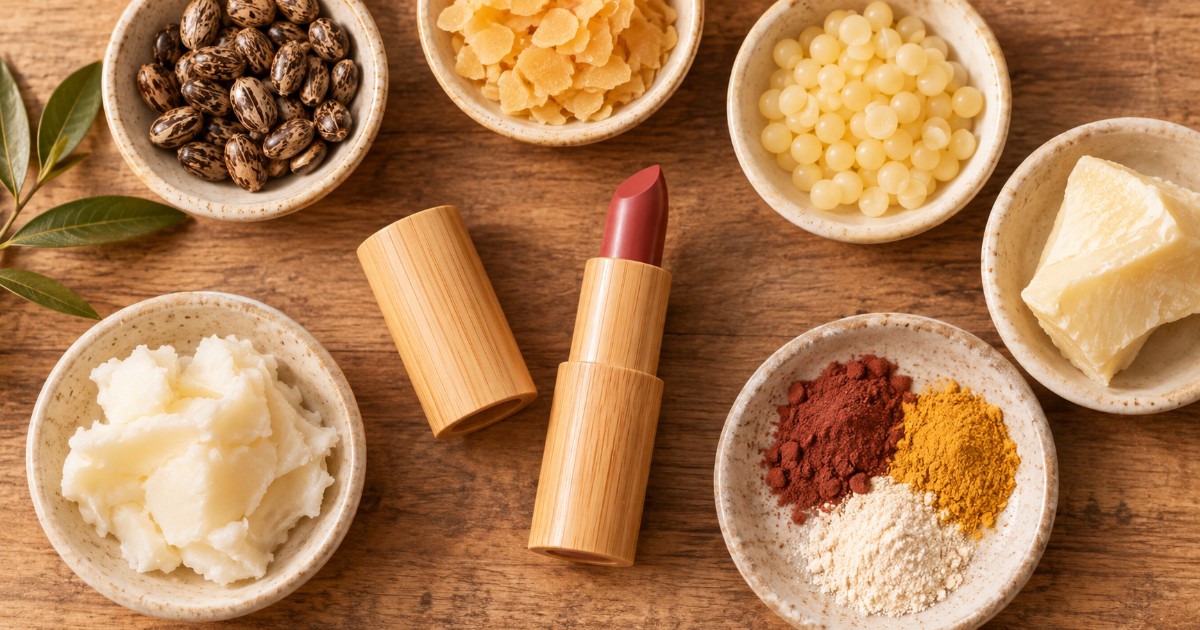
To keep this concrete, we'll walk through a real label—ours. Every noyah lipstick shares the same base formula, so this is literally what's in your tube.
The basic recipe: every lipstick has four building blocks
Strip away the marketing and nearly every lipstick—drugstore, luxury, or natural—is made from the same four categories of ingredients:
- Waxes give lipstick its shape, so it stands up in the tube and doesn't melt on contact.
- Oils make it glide, carry the pigment, and add shine.
- Butters and emollients add creaminess and help lips feel soft rather than dry.
- Pigments provide the color.
The difference between one lipstick and another comes down to which waxes, oils, and pigments a brand chooses, and what else gets added—fragrance, preservatives, plasticizers, silicones, and so on. A natural lipstick sticks to ingredients from plants, minerals, and (sometimes) bees.
Our label, decoded
Here's the full ingredient list for noyah lipstick, in order (ingredients are listed from most to least):
Ricinus Communis (Castor) Oil, Cera Alba (Beeswax), Copernicia Cerifera (Carnauba) Wax, Candelilla Wax, Helianthus Annuus (Sunflower) Seed Oil, Butyrospermum Parkii (Shea Butter), Theobroma Cacao (Cocoa) Butter, Simmondsia Chinensis (Jojoba) Seed Oil, Cocos Nucifera (Coconut) Oil, Citrus Grandis (Grapefruit) Seed Extract, Tocopheryl Acetate (Vitamin E), Cocos Nucifera (and) Eupatorium Rebaudianum Bertoni Leaf Extract. [May Contain +/-: Titanium Dioxide (CI 77891), Iron Oxides (CI 77491, CI 77492, CI 77499), Mica.]
Here's the same list in a table, so you can see what each ingredient does:
| Ingredient (label name) | What it is | What it does in lipstick |
|---|---|---|
| Ricinus Communis (Castor) Oil | Oil pressed from castor seeds | Base; disperses pigment evenly, adds shine and grip |
| Cera Alba (Beeswax) | Wax made by honeybees | Structure; smooth, cushioned feel |
| Copernicia Cerifera (Carnauba) Wax | Wax from Brazilian palm leaves | Keeps the bullet firm in warm weather |
| Candelilla Wax | Wax from a desert shrub | Structure and sheen |
| Helianthus Annuus (Sunflower) Seed Oil | Seed oil | Light glide |
| Butyrospermum Parkii (Shea Butter) | Butter from shea nuts | Creaminess, comfort |
| Theobroma Cacao (Cocoa) Butter | Butter from cacao beans | Melts at body temperature for smooth application |
| Simmondsia Chinensis (Jojoba) Seed Oil | Liquid plant wax | Softness, slip |
| Cocos Nucifera (Coconut) Oil | Oil from coconuts | Slip and softness |
| Citrus Grandis (Grapefruit) Seed Extract | Plant extract | Commonly used in natural formulas |
| Tocopheryl Acetate (Vitamin E) | Antioxidant | Helps protect oils from going rancid |
| Coconut and stevia leaf extract | Plant extracts | A subtle, sugar-free sweetness |
| Titanium dioxide, iron oxides, mica | Mineral pigments | Color, opacity, and soft shimmer |
Now let's go through them one by one.
Castor oil: the backbone of most lipsticks
Castor oil, pressed from the seeds of the castor plant, is the first ingredient in a huge number of lipsticks, not just natural ones. It's thick and glossy, it disperses pigment beautifully so color goes on evenly, and it helps lipstick cling to lips. It's also on the American Academy of Dermatology's list of ingredients recommended for dry lips.
Beeswax, carnauba, and candelilla: the structure
Three waxes work as a team. Beeswax gives a smooth, flexible structure and a comfortable, cushioned feel. Carnauba wax, from the leaves of a Brazilian palm, is one of the hardest natural waxes, so it keeps the bullet firm in warm weather. Candelilla wax, from a desert shrub, adds structure and a little sheen. Blending them balances firmness and glide. (We go deep on these three in beeswax vs. plant waxes.)
Sunflower, jojoba, and coconut oil: the glide
These lighter oils soften the formula so it spreads easily. Jojoba is technically a liquid wax rather than an oil and is famously similar to the skin's own sebum. Sunflower seed oil is light and rich in fatty acids. Coconut oil adds slip and softness.
Shea and cocoa butter: the comfort
Butters give lipstick that creamy, cushiony feel and help keep lips from feeling dry under color. Shea butter is another AAD-listed ingredient for dry lips. Cocoa butter—yes, from the same bean as chocolate—melts right at body temperature, which is why lipstick softens as you apply it.
Grapefruit seed extract and vitamin E: keeping it fresh
Vitamin E (tocopheryl acetate) is an antioxidant. Natural oils can slowly oxidize and go rancid; vitamin E helps protect them. Grapefruit seed extract is a plant extract that's commonly included in natural formulas alongside it.
Coconut and stevia leaf extract: a hint of sweetness
That last long name—Cocos Nucifera (and) Eupatorium Rebaudianum Bertoni Leaf Extract—is coconut and stevia leaf. It's there for a subtle, pleasant taste, without sugar or synthetic flavoring.
Mineral pigments: the color
Finally, the color. Our lipsticks use mineral pigments:
- Titanium dioxide (CI 77891): a white mineral that brightens, lightens, and adds opacity. We use non-micronized titanium dioxide, meaning it isn't ground down to nanoparticle size.
- Iron oxides (CI 77491, 77492, 77499): red, yellow, and black, respectively. Blended in different proportions, they create everything from nudes to browns to deep reds.
- Mica: a naturally occurring mineral that adds soft light-reflection and dimension.
All three are on the FDA's list of color additives permitted in cosmetics, including products used on the lips.
What "May Contain +/-" means
That bracket at the end isn't a hedge—it's a labeling convention. Because every shade uses the same base but a different blend of pigments, brands list all possible colorants once with "may contain" (shown as "+/-"). Your Wink tube has a different pigment ratio than your Malbec tube, but both draw from the same short list.
What you won't find on our label
Just as useful as what's in a formula is what isn't:
- No petrolatum or mineral oil. Conventional lipsticks often use petroleum-derived ingredients for slip and shine. (Here's our honest take on petrolatum.)
- No carmine. Many reds and pinks are colored with the insect-derived pigment; ours use mineral pigments instead. (What carmine is.)
- No synthetic dyes like the "Red 7 Lake" or "Yellow 5" you'll see on many labels.
- No parabens, phthalates, or sulfates.
- No synthetic fragrance.
One honest note: because our lipsticks contain beeswax, they're cruelty-free but not vegan. Our beeswax comes from farms committed to the health of their bees, and every other ingredient in the formula is vegan.
How to read any lipstick label in 30 seconds
- Check the first three ingredients. That's most of the formula. Is it castor oil and waxes, or petrolatum, mineral oil, and silicones?
- Find the colorants. Look for "CI" numbers, iron oxides, mica, or names like "Red 7 Lake." If you avoid carmine, look for carmine, CI 75470, or cochineal.
- Look for fragrance or flavor. If your lips are sensitive, "fragrance" or "parfum" is the first thing to watch.
- Notice the length. Short isn't automatically better, but a list you can actually read is easier to trust. (More on what labels like "clean" do and don't mean in natural vs. organic vs. clean beauty.)
Where noyah comes in
Our goal with lipstick is the same as with everything we make: a formula short enough that you can understand it in one read. Our natural lipsticks are semi-matte, colored with mineral pigments, made in the USA, and USDA Certified Biobased—meaning independent lab testing verified how much of their carbon comes from plants rather than petroleum. They come in bamboo tubes that cut plastic waste by about 60%.
If you're curious, start with an everyday shade like Wink, our go-anywhere nude, or a richer one like Malbec, a wine-inspired semi-matte. Or pick three with our Bundle 3 & Save.
Frequently asked questions
What is lipstick made of? Nearly all lipsticks are made from four types of ingredients: waxes for structure, oils for glide and shine, butters or emollients for comfort, and pigments for color. Natural lipsticks use plant-based oils and waxes, beeswax, and mineral pigments instead of petroleum-derived ingredients and synthetic dyes.
Why is castor oil in so many lipsticks? Castor oil is thick, glossy, and excellent at dispersing pigment evenly, which helps color go on smoothly and cling to lips. It's often the first ingredient in both conventional and natural lipsticks.
What are mineral pigments in lipstick? Mineral pigments are colorants derived from minerals, such as iron oxides (red, yellow, black), titanium dioxide (white), and mica (shimmer). They're blended to create different shades and are approved by the FDA for use in lip products.
What does "may contain" mean on a lipstick label? It means the same ingredient list covers several shades, each made with a different mix of the listed pigments. Your specific shade contains some, not necessarily all, of the colorants listed after "may contain."
Is natural lipstick vegan? Not always. Many natural lipsticks use beeswax, which isn't vegan, and some use carmine, which is insect-derived. Check for beeswax (cera alba) and carmine (CI 75470) on the label. noyah lipsticks contain beeswax but no carmine.
Shop the post: All natural lipsticks · Wink · Malbec · Bundle 3 & Save
Sources
- U.S. Food and Drug Administration, Summary of color additives for use in the United States
- American Academy of Dermatology, 7 dermatologists' tips for healing dry, chapped lips
Please complete your information below to login.
Create New Account