
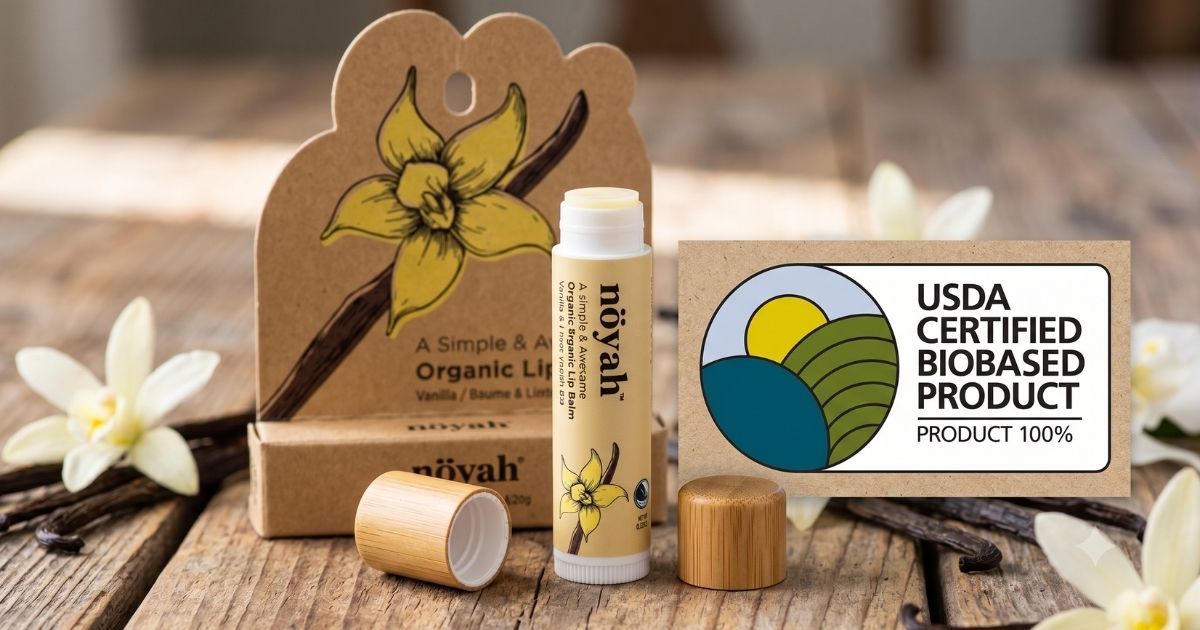
What Does “USDA Certified Biobased” Even Mean?
You’ve seen the seal—a little circle that says USDA Certified Biobased, often with a percentage stamped on it. It looks official because it is, but “biobased” isn’t exactly a word that comes up at dinner. So what does USDA Certified Biobased actually mean, and is it the green badge of honor it appears to be? The short answer: it’s a real, government-backed, lab-verified claim that measures one very specific thing—and understanding exactly what that thing is (and isn’t) makes you a much sharper reader of beauty labels.
“Biobased” in plain English
A biobased product is one made, in whole or significant part, from biological materials—plants, agricultural crops, forestry materials—instead of from petroleum. That’s the whole concept. Conventional ingredients are often built from fossil carbon dug out of the ground; biobased ingredients are built from renewable carbon that was, until recently, growing in a field.
The label puts a number on it. “Biobased content” is the percentage of a product’s carbon that comes from those renewable sources rather than from petroleum. A balm that’s 100% biobased contains carbon that is entirely plant-derived. The number is the headline—and, refreshingly, it’s not a number the company gets to make up.
Who’s behind the seal: the USDA BioPreferred Program
The label comes from the USDA BioPreferred Program, created by Congress to grow the market for products made from renewable materials. There are two halves: a federal-procurement side (which nudges government agencies to buy biobased) and a voluntary labeling side—that’s the consumer-facing seal you spot on a product. When a company earns it, the USDA is effectively standing behind the accuracy of the biobased percentage printed on the label. It’s not a sticker a brand prints for itself.
How it’s verified: yes, actual radiocarbon dating
This is the part we find genuinely delightful, and it’s the reason the seal has teeth. Biobased content isn’t self-reported—it’s measured in an independent laboratory using a standardized test (ASTM D6866) that relies on radiocarbon analysis. The same basic science archaeologists use to date ancient bones is used to date the carbon in your lip balm.
Here’s why it works. Carbon from living plants contains a tiny, predictable amount of a radioactive form called carbon-14, which decays slowly over thousands of years. Carbon from petroleum is so old—millions of years buried underground—that its carbon-14 has long since vanished. So a lab can measure the carbon-14 in a product and tell, with real precision, how much of its carbon came from recently-living plants versus ancient fossil sources. Plant carbon “reads” as recent; petroleum carbon reads as a flat zero. The ratio is your biobased percentage.
As our founder likes to put it, it’s a “fancy way of describing a radiocarbon decay analysis proving the carbon in a product is natural.” A brand can’t fudge it, round up, or vibe its way to a number. A lab either measures the plant carbon or it doesn’t.
How much counts as “biobased”?
Not every product needs to hit 100%. The USDA sets minimum thresholds, and they vary by product category. For categories without a specific standard, a product generally needs at least 25% biobased content to qualify for the label—while many products land far higher. The exact percentage a product achieves gets printed right on the seal, so a thoughtful shopper can compare a 30% product against a 90% one at a glance.
Important: what the seal does NOT mean
Here’s where we earn your trust by telling you what the label can’t do. USDA Certified Biobased is not a blanket environmental or sustainability seal of approval. The USDA itself is clear on this point. It certifies one thing—the proportion of renewable versus petroleum-based carbon—and that’s it.
So the seal does not, on its own, tell you a product is organic, that it’s cruelty-free, that it’s free of any particular ingredient, or that it was produced with a low carbon footprint. It’s not measuring how the plants were farmed or how the product was packaged. A product can be highly biobased and still raise other questions; a product can be wonderful in other ways and not carry the seal at all. Biobased is a meaningful, verified data point—just a narrow one. Treat it as one honest line on the label, not the entire story.
Why this matters more for lip care than you’d think
Stack this on top of something we keep coming back to: you swallow a little of your lip products no matter what. Given that, “is the carbon in this made from plants or petroleum?” stops being abstract. A high biobased percentage means more of what’s on (and incidentally in) you traces back to a field rather than an oil well. It pairs naturally with the natural ingredients behind the number—the plant oils, butters, and waxes that make a biobased balm biobased in the first place.
Where Noyah stands
Nearly everything we make is USDA Certified Biobased, and several of our products are certified at 100%. Some are made from 100% food—literally formulated in kitchens rather than chemical plants. We pursue the certification precisely because it’s third-party and unfakeable: it’s one of the few label claims in beauty where an independent lab, not a marketing team, supplies the number.
We’re also not going to oversell it. Biobased is one piece of how we think about cleaner products, alongside USDA Organic certification, cruelty-free practices, and eco-friendlier packaging. Each answers a different question, and we’d rather you understand what each one means than treat any single seal as a magic word. If you want the bigger picture, our certified-biobased lip balms are a good place to see all of it working together—and why these certifications matter to us is the rest of the story.
Frequently asked questions
What does USDA Certified Biobased mean?
It means a product has been independently tested and verified to contain a certain percentage of carbon derived from renewable plant and agricultural sources rather than petroleum. The USDA BioPreferred Program backs the accuracy of the biobased percentage shown on the label.
How is biobased content measured?
Through laboratory testing using a standardized method (ASTM D6866) based on radiocarbon analysis—the same science used in carbon dating. Because plant carbon contains carbon-14 and petroleum carbon doesn’t, a lab can precisely measure what share of a product’s carbon is plant-derived.
Does USDA Certified Biobased mean a product is organic or sustainable?
No. The seal certifies only the proportion of renewable versus petroleum-based carbon. It does not by itself mean a product is organic, cruelty-free, free of specific ingredients, or low-carbon-footprint. It’s one specific, verified claim—not an all-purpose environmental badge.
What percentage of a product has to be biobased to earn the label?
It varies by product category. For categories without a specific USDA standard, a product generally needs at least 25% biobased content to qualify, though many exceed that. The exact percentage achieved is printed on the seal.

Validate your login
Create New Account