
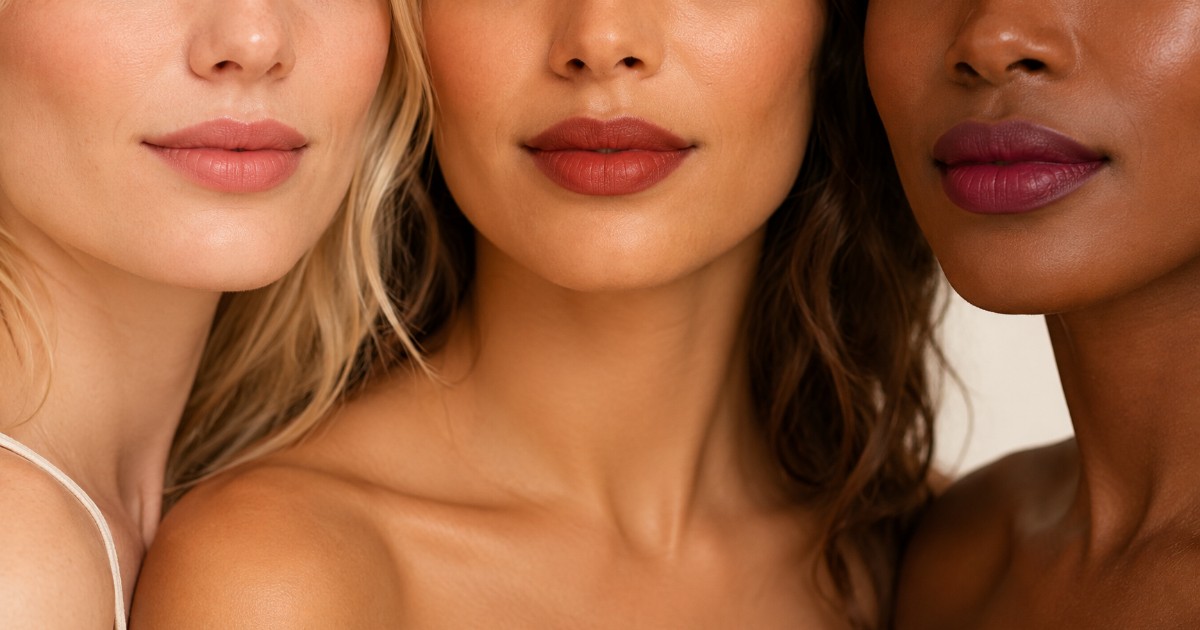
How to Choose a Lipstick Color for Your Skin Tone (Without Overthinking It)
Most of us have a lipstick graveyard: the shade that looked incredible on the model, in the store light, on your friend—and somehow made you look tired, washed out, or like you'd been eating a popsicle. It's rarely the lipstick's fault. Usually it's a mismatch with your undertone, the subtle color sitting beneath the surface of your skin. Once you know yours, choosing a lipstick for your skin tone stops being a guessing game. Here's how to figure it out in a couple of minutes, and which shades tend to flatter each one.
The quick answer: Choose lipstick by your undertone first, then your skin depth. Cool undertones (blue veins, silver jewelry) suit berries, wines, and blue-reds. Warm undertones (green veins, gold jewelry) suit brick reds, corals, and warm nudes. Neutral undertones can wear almost anything, especially dusty rose and mauve.
Skin tone vs. undertone: they're not the same thing
Skin tone (or depth) is how light or deep your skin is—fair, light, medium, tan, deep. It can change with the seasons and a summer at the beach.
Undertone is the hue underneath—cool (pink, red, or bluish), warm (yellow, golden, or peachy), or neutral (a balance of both). Some people also have an olive undertone, a greenish-golden cast that can read neutral-to-warm. Your undertone doesn't change with a tan, and it's the bigger factor when it comes to which lip colors look "right" on you.
Two people with the same skin depth can look completely different in the same red—because one is warm and the other is cool.
How to find your undertone in two minutes
Try two or three of these in natural daylight, with a bare face:
- The vein test. Look at the veins on the inside of your wrist. Mostly blue or purple suggests cool. Mostly green suggests warm. Hard to tell, or a mix? Likely neutral.
- The jewelry test. Does silver make your skin look brighter? Probably cool. Does gold look better? Probably warm. Both equally? Neutral.
- The white-shirt test. Hold pure white and off-white (cream) fabric up to your face. If stark white looks better, you're likely cool; if cream is more flattering, you're likely warm.
- The sun test. Do you burn easily and rarely tan? That often goes with a cool undertone. Do you tan easily? Often warm. (Not foolproof—use it as a tiebreaker.)
If the results disagree with each other, you're probably neutral. Good news: that's the most flexible undertone of all.
The simple rule: match the undertone, then play with depth
Here's the shortcut most makeup artists use:
- Cool undertones usually glow in lip colors with blue or purple in them: berries, plums, wine, blue-reds, cool pinks, and mauves.
- Warm undertones usually light up in colors with yellow, orange, or brown in them: brick reds, corals, peaches, terracottas, warm nudes, and chocolate browns.
- Neutral undertones can wear most of both families, and especially suit muted, in-between shades like dusty rose, mauve, and true reds.
| Undertone | How to spot it | Lip colors that usually flatter | noyah shades to try |
|---|---|---|---|
| Cool | Blue/purple veins; silver flatters; burns easily | Berry, wine, plum, blue-red, cool pink | Malbec, Currant News, Empire Red, Smoke |
| Warm | Green veins; gold flatters; tans easily | Brick red, coral, peach, warm nude, brown | African Nights, Dolled Up, Wink, Summertime Peach gloss |
| Neutral | Mixed veins; silver and gold both work | Dusty rose, mauve, true red | Desert Rose, Deeply in Mauve gloss, Empire Red |
Then adjust for depth. As a general guide, lighter skin often looks most natural in softer, sheerer versions of a color, while deeper skin shows off rich, highly pigmented shades beautifully—and pale, chalky nudes can look ashy. But "general guide" is the key phrase. The best way to know is still to try it on.
Shade ideas by undertone
If you're cool-toned
Reach for colors with a blue or purple base. Berry and wine tones are especially flattering.
- Malbec — a semi-matte, wine-inspired rose-berry that works day to night.
- Currant News — a deep, bold plum for when you want a statement.
- Empire Red — a classic red with a cool, crimson lean.
- Smoke — a pigmented matte lavender-grey. Unexpected, and striking on cool skin.
If you're warm-toned
Look for shades with golden, orange, or brown undertones.
- African Nights — a sultry brick red, the classic warm-skin red.
- Dolled Up — a bright warm pink that edges toward coral. Our brightest lipstick.
- Wink — a warm, everyday nude.
- Summertime Peach gloss — a peachy-pink you can wear alone or layer over a nude.
If you're neutral
You can borrow from both lists, and muted shades are your sweet spot.
- Desert Rose — a subtle dirty pink that's deliberately on the softer side of pigmentation. Easy to wear anywhere.
- Deeply in Mauve gloss — a flattering mauve that's sheer in one coat and buildable for more color.
- Empire Red or African Nights — try both reds; neutrals can often wear either.
How to pick a red lipstick for your skin tone
Red is the shade people most often ask about, and the undertone rule matters most here:
- Cool undertones: look for blue-based reds, like crimson, cherry, and raspberry-red. They make teeth look brighter. Try Empire Red.
- Warm undertones: look for orange- or brick-based reds, like tomato, rust, and terracotta. Try African Nights.
- Neutral undertones: a true, balanced red works best. You can usually wear both of the above.
- Depth matters too: fair skin often suits a slightly sheerer or brighter red, medium skin can carry nearly any red, and deep skin looks stunning in rich, deep reds and wine-reds.
Want to know what makes a red "clean"? We answered that in What makes a red lipstick clean?
Finding your nude
The nude lip is the hardest to get right, because the whole point is to look like your lips, only better. A few rules of thumb (we went deeper in our classic post, Get in the Nude):
- Match your lips, not your skin. A nude that matches your face can erase your mouth entirely. Aim for one or two shades deeper than your natural lip color.
- Fair skin: soft pinky-beiges and sheer taupes, like our Latte Love gloss.
- Medium and olive skin: warm rosy-beiges and caramels—Wink is a great start.
- Deep skin: rich browns, mochas, and cocoa-roses rather than pale beiges. Our Melted Mocha gloss is a wearable chocolate shade that goes on strong or sheers out.
A few tips that matter more than any chart
- Test on your fingertips, not the back of your hand. Fingertips are pinker and closer in tone to your lips.
- Look in daylight. Store lighting lies.
- Your natural lip color changes the result. Very pigmented lips will deepen a shade; pale lips will show it truer. A sheer gloss shows this the most.
- Consider your teeth. Blue-based reds and berries tend to make teeth look whiter; orange-based shades can bring out yellow.
- Rules are suggestions. If you love a color "you shouldn't wear," wear it. Confidence beats undertone theory every time.
Once you've found your shade, make it last—our tips on making lip color last still hold up.
Where noyah comes in
We designed our lipstick range to cover the whole spectrum—a go-anywhere nude, soft pinks, warm and cool reds, wine and plum, and one wildcard grey—so there's something that works with your undertone, whatever it is. Every shade is semi-matte, made with mineral pigments, and shares the same short formula of plant oils, butters, and waxes (we break it down ingredient by ingredient in what's in natural lipstick).
Still torn between two or three? That's what our Bundle 3 & Save is for: pick any three lipsticks for $48. And if a shade truly isn't what you thought it would be, you can return it (see our return policy).
Frequently asked questions
What lipstick color is right for my skin tone? Start by finding your undertone (cool, warm, or neutral) using the vein, jewelry, or white-shirt test. Cool undertones tend to suit berry, wine, and blue-red shades; warm undertones suit brick reds, corals, and warm nudes; neutral undertones can wear most colors, especially muted shades like dusty rose and mauve.
What lipstick color looks good on everyone? Muted, balanced shades—dusty roses, mauves, and true reds that aren't strongly orange or blue—tend to flatter the widest range of skin tones. A sheer, buildable formula is also more forgiving than a highly pigmented one.
What's the best red lipstick for warm undertones? Warm undertones usually look best in reds with an orange or brick base. Cool undertones tend to suit blue-based crimson and cherry reds.
How do I find the right nude lipstick? Choose a nude one to two shades deeper than your natural lip color rather than matching your skin. Fair skin suits pinky-beiges, medium and olive skin suits rosy-beiges and caramels, and deep skin suits rich browns and mochas.
Does skin tone or undertone matter more for lipstick? Undertone usually matters more for whether a color looks harmonious; skin depth affects how intense or sheer that color should be.
Shop the post: All lipsticks · All glosses · Bundle 3 & Save
Please complete your information below to login.
Create New Account