
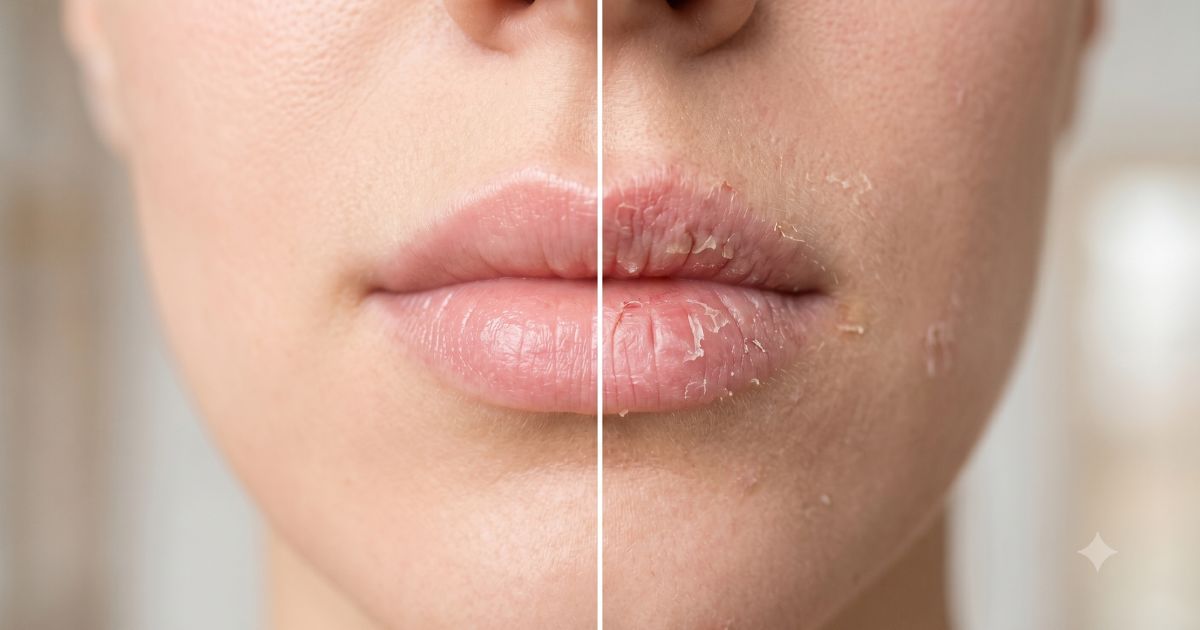
Why Are Lips So Prone to Chapping?
You moisturize your face. You probably have opinions about your serum. And yet your lips spend half the year flaking, cracking, and staging a quiet rebellion the moment the temperature drops. So why do lips get chapped when the skin two centimeters away is doing just fine? It turns out your lips are working with a fraction of the equipment—and once you understand what they’re missing, every confusing thing about them (the constant dryness, the licking that makes it worse, the balm that somehow makes it worse too) suddenly makes sense.
Your lips are skin—just the bare-bones version
Think of the skin on your arm as a fully loaded model: it comes with a thick protective top layer, oil glands, sweat glands, and hair follicles, all quietly cooperating to keep moisture in. Your lips got the stripped-down trim. Same basic structure—epidermis, dermis, the works—but missing nearly every feature that does the protecting.
Start with the outer wall. Skin’s topmost layer, the stratum corneum, is the barrier that stops water from escaping your body. On your face it’s a solid stack of cell layers. On your lips it’s a thin little curtain—by some measures around 75% thinner than facial skin, built from a mere three to six layers of cells where your cheek has fifteen or sixteen. Less wall means less defense, which is also, incidentally, why your lips are pink: the barrier is so sheer that the blood vessels underneath show right through.
The big one: no oil glands, no backup plan
Here’s the detail that explains everything. The rest of your skin has sebaceous glands—tiny oil factories that pump out sebum to keep things soft and sealed. Lips have none. No sebaceous glands, no sweat glands, no hair follicles. As we’ve written before, lips don’t make their own moisture, which means they can’t self-correct the way your face does. When your cheek gets dry, it can ramp up oil production. When your lips get dry, they just… stay dry, and wait for you to do something about it.
Dermatologists put it plainly. As Dr. Reshmi Kapoor, a Brooklyn dermatologist, explained to CNN, lips lack the protective layers and oil-producing glands that prevent moisture loss elsewhere, so they dry out the instant conditions turn against them. Their only built-in source of moisture is saliva—and as you’re about to see, saliva is a deeply unreliable ally.
Why winter (and summer, and that flight) wrecks them
Because your lips have almost no defenses, they feel every environmental insult immediately. Cold air holds very little moisture, so it pulls water straight out of that thin barrier. Wind speeds the process along. Dry indoor heat does the same thing from the inside of your apartment. Low humidity on an airplane is a perfect storm. And it’s not only a cold-weather problem—sun is just as rough.
That last one catches people off guard. Lips have no melanin to speak of—none of the pigment that gives the rest of your skin a bit of natural UV defense—so they burn easily and cumulatively. Sun exposure leaves them cracked and swollen now, and contributes to thinning over time. The takeaway: your lips need protection in July as much as in January, which is why a daytime balm with SPF earns its place. (Your face would never go outside unprotected; your lips deserve the same courtesy.)
The lip-lick trap: how “relief” makes it worse
Your lips feel dry. So you lick them. For about four seconds, relief. Then the saliva evaporates—taking a little of your lips’ own moisture with it—and they feel even drier than before. So you lick them again. Congratulations: you’ve entered the loop.
It gets worse than simple evaporation. Saliva contains digestive enzymes—the same ones that start breaking down your lunch. On the fragile skin of your lips, those enzymes nibble at the already-thin barrier, degrading it further. Once the barrier is damaged, water escapes faster, the lips get drier and flakier, and dry flaky lips are nearly impossible to leave alone. Lick, dry, pick, repeat. If your lips are perpetually chapped and you’re a chronic licker, you’ve likely found your culprit.
When chapped lips are trying to tell you something
Most of the time, chapped lips are just the predictable result of under-equipped skin meeting harsh conditions. But not always. Persistent chapping that won’t respond to any amount of balm can occasionally point to something else—a vitamin deficiency, thyroid issues, an allergic reaction to an ingredient (ironically, often something in a lip product), or angular cheilitis, an inflammatory condition that shows up as cracks at the corners of the mouth and is frequently mistaken for ordinary chapping.
None of that is cause for alarm, but it’s a reason not to just keep slathering. If your lips stay cracked for weeks despite a sane routine, that’s a conversation for a dermatologist, not a fifth tube of balm. We’re a lip care company, not your doctor—and the honest advice is to see one if something isn’t healing.
How to actually keep your lips from chapping
Since your lips can’t protect themselves, the whole job is to do it for them—consistently, and without sabotaging the barrier you’re trying to rebuild. The short version:
- Seal, don’t just wet. Reach for a balm that actually repairs the barrier—rich plant butters and waxes that lock moisture in. Shea butter is a dermatologist favorite for exactly this. A bare, fragrance-free barrier balm beats a glossy one that evaporates.
- Stop licking. Easier said than done, but it’s the single highest-impact change. When the urge hits, apply balm instead. You’re breaking the loop.
- Protect against sun, year-round. A daytime balm with mineral SPF (zinc oxide or titanium dioxide, which are the least irritating) guards the melanin-free zone your lips can’t guard themselves.
- Exfoliate gently—and rarely. A weekly, soft sugar scrub can lift flakes, but go easy. Aggressive scrubbing strips the already-thin barrier and makes things worse. Think polishing, not sanding.
- Hydrate from the inside. Drink water. No balm can compensate for a body running on cold brew and optimism.
- Read the label. Some lip products quietly make chapping worse—menthol, camphor, and certain flavorings can irritate and dry. If a balm tingles, that’s not it working; that’s often it irritating.
Where Noyah fits in
This is the whole reason we exist. If your lips can’t make their own moisture and you’re going to be reapplying something to them all winter—and ingesting a little of it along the way—then what that something is made of matters enormously. Our lip balms are built around the ingredients dermatologists actually point to: organic plant oils and butters that seal and repair, with none of the menthol-camphor-fragrance saboteurs that send you back into the chapping loop.
Better still, they’re USDA Certified Organic and made from food-grade ingredients—because, as we keep saying, if you’ll end up eating a little of it, it should be made like food. So a barrier balm that actually repairs can do its job without introducing anything you’d rather not think about. And for the flakes, a gentle exfoliation step—used sparingly—clears the way without wrecking the barrier underneath.
Frequently asked questions
Why do my lips get chapped but the rest of my face doesn’t?
Because lip skin is missing the equipment your facial skin has. Lips have a much thinner protective outer layer (the stratum corneum) and no sebaceous (oil) glands, sweat glands, or hair follicles. They can’t produce their own moisture, so they dry out far faster than skin that can.
Does licking your lips really make chapping worse?
Yes. Saliva evaporates quickly and takes some of your lips’ moisture with it, leaving them drier than before. Saliva also contains digestive enzymes that degrade the lips’ already-fragile barrier. The result is a cycle: lick, dry out more, lick again.
Why do lips need SPF if they’re only chapped in winter?
Lips have virtually no melanin, the pigment that gives the rest of your skin some natural UV protection. That makes them easy to sunburn and vulnerable to cumulative sun damage year-round—not just in summer. A daytime balm with mineral SPF helps.
When should I see a doctor about chapped lips?
If your lips stay cracked or sore for several weeks despite a gentle, consistent routine, it’s worth checking in with a dermatologist. Persistent chapping can occasionally signal a vitamin deficiency, thyroid issue, an ingredient allergy, or angular cheilitis (cracks at the mouth’s corners). This isn’t medical advice—just a nudge to get it looked at if it isn’t healing.
Validate your login
Create New Account