
Does Lip Balm Expire? How to Tell (and Why Preservative-Free Matters)
You’ve almost certainly got one rattling around a bag or coat pocket that’s been there since… well, you’d rather not say. It still twists up, still glides on, so it’s fine, right? Not necessarily. Lip balm does expire—and the more natural your balm, the sooner it happens. Here’s the honest version of how lip balm shelf life works, how to tell when yours has turned, and why “no preservatives” comes with a small catch worth knowing about.
Yes, lip balm expires—here’s the timeline
Unopened and stored somewhere cool and dark, most lip balm keeps for a year or two. But the clock that really matters starts the moment you open it. Once a balm meets air, your lips, and the bacteria that live around your mouth, its lifespan shortens considerably. For most balms, that opened lifespan runs roughly 6 to 12 months.
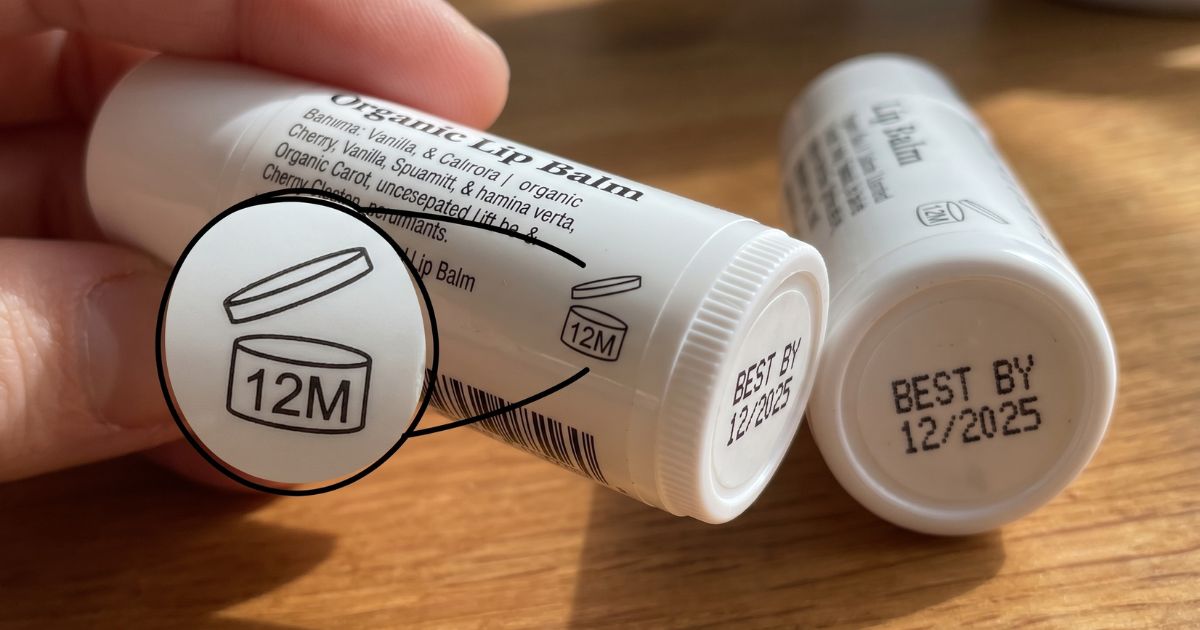
How do you know your specific tube’s number? Look for the PAO symbol—the little open-jar icon with a number like “12M” or “6M” printed on the packaging. “PAO” stands for “period after opening,” and that number is how many months the product is meant to stay good once you’ve broken the seal. In the US, cosmetics aren’t federally required to carry a fixed expiration date, so the PAO is often your best guide. No symbol at all? A safe default is to assume about 12 months after opening for a standard balm—and less for a natural one.
The honest part: natural balms expire faster
Here’s the tradeoff we’d rather just tell you about. Lip balms made with natural oils, butters, and waxes—and without synthetic preservatives—generally have a shorter shelf life than fully synthetic ones. Often closer to 6–12 months opened, and sometimes the shorter end of that. It’s not a flaw; it’s physics.
Two things are happening. First, natural plant oils and butters—coconut, shea, and the like—can oxidize over time, which is what gives an old balm that faintly rancid, crayon-ish smell. Second, synthetic preservatives (the parabens, phenoxyethanol, and similar that many conventional balms include) exist specifically to hold off mold, yeast, and bacteria for longer. Leave those out, and you lose that extended buffer. So the very thing that makes a balm appealingly simple—short ingredient list, nothing synthetic—is also what gives it a shorter runway. Worth it, in our view. But worth knowing.
How to tell if your lip balm has gone bad
Your senses are surprisingly good at this. A balm has likely turned if you notice any of the following:
- Smell: a sour, rancid, waxy, or ‘off’ crayon-like scent. A healthy balm smells faintly of its flavor or of nothing much; rancid is unmistakable once you know it.
- Texture: grainy, gritty, unusually hard, or separated and oily. Any change from its original smooth glide is a flag.
- Color: darkening, yellowing, cloudiness, or odd spots—especially in tinted balms, where it can signal oxidation or contamination.
- Your lips: itching, redness, swelling, or small bumps after applying can mean the formula has degraded or picked up bacteria. Stop using it.
Important caveat: a balm can be past its prime even when it looks and feels totally normal. Ingredients degrade invisibly, and SPF balms in particular lose potency well before anything looks wrong. When a balm is well past its PAO, “it seems fine” isn’t quite enough—lean on the date.
What’s the actual risk of using an expired one?
Mostly it’s underwhelming performance—a balm that’s oxidized won’t moisturize as well, and any SPF won’t protect as promised. The more real concern is contamination. Because you apply balm directly to sensitive tissue and reintroduce mouth bacteria with every use, an old balm can harbor microbes that lead to irritation or, less commonly, infection. It’s rarely an emergency—but “probably fine” isn’t a thrilling standard for something you eat a little of daily. If a product looks or smells wrong, or has caused a reaction, toss it; if you have a persistent reaction, check with a professional.
How to make your lip balm last as long as possible
- Date it. Write the opening date on the tube with a marker. You will not remember otherwise—nobody does.
- Keep it cool and dry. Heat and humidity accelerate oxidation and microbial growth. The glove compartment in summer is a balm graveyard; a cool drawer is ideal.
- Prefer twist-up tubes over pots. Tubes limit air and finger contact. If you use a pot, apply with a clean fingertip or a spatula, not a previously-licked finger.
- Cap it tightly, every time. Air and dust are the enemy. A loose cap shortens the clock.
- Don’t share. Sharing balm shares bacteria and shortens its life (and yours, socially, if anyone finds out).
- Buy a size you’ll actually finish. With natural balms especially, a smaller tube used up in a few months beats a giant one going rancid half-full.
Where Noyah comes in
We make preservative-free balms on purpose—our classic is essentially four kitchen ingredients, with nothing synthetic added to extend its life artificially. The honest consequence, as this whole article has argued, is that ours are best used fresh rather than stored for years. We think that’s the right tradeoff: we’d rather make something simple and clean that you finish in a season than something that lasts three years because it’s full of things we chose to leave out.
It also fits how we think about lip care generally. If you’re going to eat a little of it, fresher and simpler is better—and a balm you use up happily in a few months never gets the chance to oxidize in a drawer. That’s rather the point of how we make them.
Frequently asked questions
How long does lip balm last after opening?
Most lip balms last about 6 to 12 months once opened. Check the PAO symbol (the open-jar icon with a number like “12M”) for the specific product. Natural, preservative-free balms tend toward the shorter end of that range.
Why do natural lip balms expire faster?
Two reasons: their plant oils and butters can oxidize and go rancid over time, and they lack the synthetic preservatives that extend a conventional balm’s resistance to mold, yeast, and bacteria. The simplicity that makes them appealing also gives them a shorter shelf life.
How can I tell if my lip balm has gone bad?
Watch for a rancid or crayon-like smell, a grainy or separated texture, darkening or spotting in color, or irritation after use. Note that a balm can be expired even if it looks normal, so also go by the PAO date—especially for SPF balms, which lose potency early.
Is it bad to use expired lip balm?
At minimum it won’t moisturize or protect as well. The bigger concern is bacterial contamination from repeated mouth contact, which can cause irritation or, occasionally, infection. If it looks or smells off, or has caused a reaction, replace it—and see a professional if a reaction persists.
Validate your login
Create New Account